


Understanding Horse Markings: A Guide for New Equestrians

A spotted coat can catch your eye, but it doesn’t answer every identification question. Appaloosa is a horse breed, not simply a color; horse markings and coat patterns describe visible features that help distinguish one horse from another. A white marking over the fetlock, for example, has its own name and boundaries.
If these terms are easy to mix up, you’re not alone. Breed, base coat color, and individual markings describe different things. Understanding how they fit together makes horse descriptions clearer.
This guide explains the difference between the Appaloosa breed and a coat pattern, introduces common color and marking terms, and describes fetlock markings. You’ll also learn how a fetlock marking differs from a pastern marking or sock, so you can describe what you see with confidence.
Table of Contents
Is Appaloosa a Breed or a Colour?
Appaloosa is a breed name, while color and pattern describe appearance. Individual markings add detail when identifying a horse.
Appaloosa Patterns and Breed Identity
An Appaloosa is a horse breed recognized by its registry, the Appaloosa Horse Club. Leopard, blanket, and few-spot are coat patterns associated with Appaloosas, but a spotted appearance alone does not establish a horse’s breed. Genes influence coat patterns, and their effects can differ among breeds. Markings help describe a horse, but do not prove its ancestry.
Identification documents combine markings with details such as the horse’s name, gender, date of birth, height, and color. Describe each white area by location and extent. For example, note whether a leg marking reaches or extends above the knee or hock, and record dark or chestnut spots by color and location. Ermine spots are small dark spots within a white marking. A hoof with both light and dark coloring can be described as parti-colored.
Facial markings are white areas on the head: a star appears on the forehead, a stripe runs vertically down the face, and a snip marks the muzzle. A blaze is a broad stripe, while a bald face covers much of the face. Markings have white hair over pink skin. Scars and acquired marks, which may result from injury or identification practices, can alter the hair or skin. Describe these separately by location and appearance.
Marking Changes and Breed Clues
Marking changes are shifts in a horse’s visible coat as it ages or sheds seasonally. Foals often shed toward their adult coat color at around 2 months; in spring and fall, legs and bellies may retain winter hair longer than the topline. White markings and coat patterns can help distinguish horses, but appearance alone doesn’t determine breed or reveal a specific genetic makeup.
A freeze mark is an angle-numeric identification mark applied by the Bureau of Land Management to the left side of the neck, under the mane, on each wild horse or burro removed from the range.
Coat-color modifications and patterns
Base color, pattern, and white areas describe different aspects of a horse’s appearance. Genes influence these features, while precise terms help distinguish similar-looking horses.
Distinctive Coat-Color Patterns
A coat pattern is the distribution of colored and white hairs across the body. Roan horses have white hairs mixed with colored hairs, while the head, legs, mane, and tail remain dark. Rabicano ticking creates white flecks at the flank and white hairs near the base of the tail. A dorsal, or eel, stripe is a darker band along the back, from mane to tail.
Birdcatcher spots are small white spots, roughly the size of a dime to a quarter. They are not tied to a specific breed, may appear later in life, and can disappear. A spot marking can appear anywhere, with the hair growing in a circular swirl.
Horse Colors, Points, and Leg Markings
Base color is the horse’s underlying coat color, shaped by two main genes. The Extension gene affects black pigment: E allows black pigment, while e results in chestnut. The Agouti gene controls where black appears: A restricts it to the points, while a allows black throughout the coat. A bay has a reddish-brown coat with black points on the mane, tail, and lower legs.
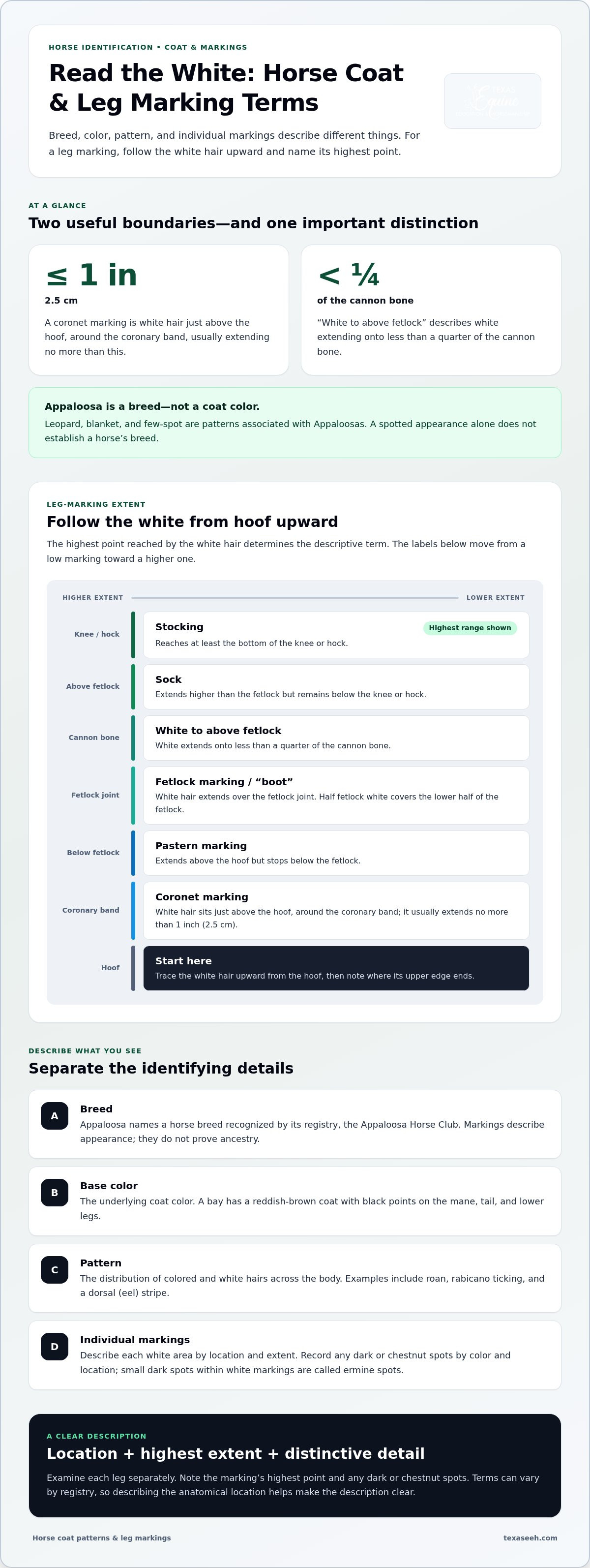
A coronet marking is white hair just above the hoof, around the coronary band, usually extending no more than 1 inch (2.5 cm). A pastern marking extends above the hoof but stops below the fetlock. A stocking reaches at least the bottom of the knee or hock. Hooves may show white and dark areas in strips or larger areas, called parti-colored.
Unusual Markings and Their Names
Unusual markings are distinctive coat features named for their appearance or location. A true dun has a dark dorsal stripe. A chestnut horse with one cream gene has a palomino coat, while two copies of the cream gene produce a cremello coat. Cremello horses have pale cream coats, pink skin, and bright blue eyes.
Piebald describes a black-and-white horse; skewbald describes a white horse with another color, such as bay or chestnut. To describe a leg marking, note its highest extent and any dark or chestnut spots by color and location. This precision helps distinguish a quarter stocking from white limited to the pastern.
Fetlock markings
A fetlock marking is white hair that extends over the fetlock joint. It may be called a “boot,” and its height distinguishes it from nearby leg markings. Look at where the white begins above the coronet, then note whether it covers the fetlock or continues onto the cannon bone. The upper edge, not the overall appearance, determines the descriptive term.
Half fetlock white means white covers the lower half of the fetlock. White to above fetlock means the white extends onto less than a quarter of the cannon bone. These terms describe different boundaries, so record what you see rather than choosing a label at a glance. Even a slightly higher edge can change the description.
A sock extends higher than the fetlock but remains below the knee or hock. A pastern marking rises above the hoof but stops below the fetlock. To distinguish them, trace the white hair upward from the coronet. In identification descriptions, a leg marking is classified by its most proximal extent, meaning the highest point it reaches. Terms can vary by registry, so describing the anatomical location provides clarity.
White leg markings can stain more readily from mud and manure, and the skin underneath is often more sensitive than pigmented skin. Chestnut or dark spots sometimes appear within white hair; describe their color and location, especially if there is just one. Examine each leg separately: markings may appear on one leg, several legs, or all four. Clear descriptions help distinguish horses with otherwise similar coats.
Texas Equine Education & Horsemanship™: Horse & Rider Showcase
Texas Equine Education & Horsemanship™ offers the Horse & Rider Showcase for readers who want to keep learning about horses and riders beyond coat descriptions. Understanding terms for color, patterns, and leg markings can help you follow what you see and describe it clearly.
To explore the horse-and-rider connection in a practical setting, continue your learning with the topic-focused Horse & Rider Showcase. It shifts attention from individual coat details to horses and riders together, without requiring you to memorize every marking term first.
Visit the Horse & Rider Showcase page to learn more.
Make careful observation part of your horsemanship
Clear descriptions start with patient observation. Take a moment to notice a horse’s overall appearance before focusing on one detail. This helps you communicate what you see without relying on assumptions or memory alone.
As you learn, practice describing different horses in your own words. Compare your notes with what you can observe, then refine them as details become clearer. This habit can make conversations about horses more precise and thoughtful.
Every horse offers something new to notice. Keep observing with curiosity and build your understanding one careful description at a time.
Frequently Asked Questions
What are Horse Markings?
Horse markings are visible features that help describe or distinguish an individual horse. They include white areas on the face or legs, distinctive hair patterns, and acquired marks. For a useful description, note each feature’s location, shape, color, and boundaries. For example, describe a white patch by identifying the leg and how high it extends.
What are common horse coat markings and where are they located?
Common white markings appear on the head and legs, though their size and placement vary. A horse may have white on one leg, both front legs, both hind legs, or all four. Pink skin beneath white hair can help show where a marking ends. Look closely at the boundary rather than relying on a general impression, especially when recording a horse’s appearance.
What are common leg markings on horses and how are they named?
Common leg-marking terms include coronet, pastern, fetlock, sock, and stocking. The name depends on the marking’s height and position on the limb. Naming conventions can differ among registries, so an anatomical description can make a record clearer. The US Arabian Horse Registry recommends examining legs in this order: right front, right hind, left front, then left hind.
How do horse markings differ from coat colors and patterns?
Markings describe distinct features on a horse, while coat color describes its overall color and a pattern describes how colors or hairs are distributed. For instance, gray is a coat color that lightens over time, whereas a localized white patch is a marking. Keeping these terms separate helps prevent a color change during the horse’s life from being mistaken for a new marking.
How are horse markings described in breed registries and official records?
Official descriptions identify markings by location and visible detail, rather than relying only on broad terms. The US Arabian Horse Registry uses submitted photographs to determine leg markings and divides each leg into eight imaginary areas to locate details. When preparing a description, note each leg separately and record where spots or disconnected white areas appear within the marking.


Comments