


The Professional Benefits of Equine-Assisted Psychotherapy

Updated: Nov 2
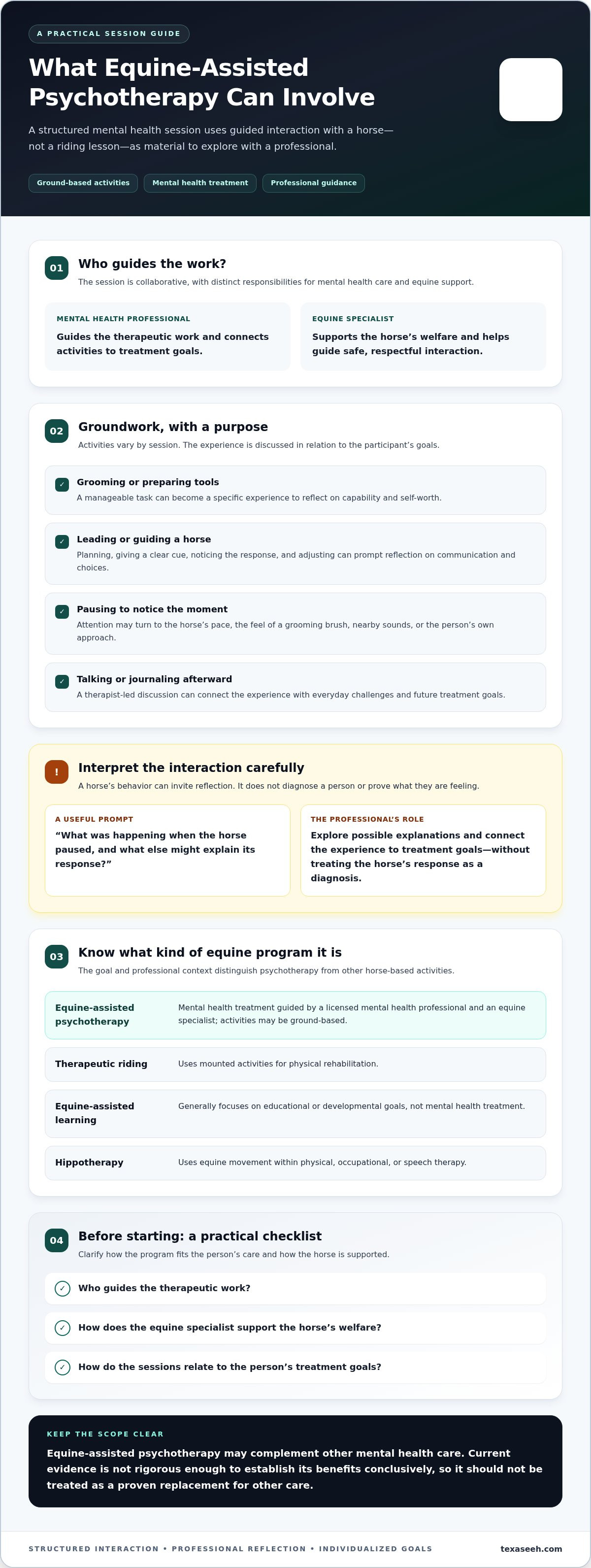
The horse isn’t there to be ridden; the interaction itself is part of the therapeutic work. Equine-assisted psychotherapy brings horses into structured mental health sessions guided by mental health professionals and equine specialists, often through ground-based activities.
It’s natural to wonder how time with a horse could relate to emotional well-being. This article explains what equine-assisted psychotherapy may involve and how sessions can support work on anxiety, self-esteem, confidence, communication, and stress. It also explains how psychotherapy differs from riding-focused programs and why it is generally used alongside, rather than instead of, other mental health care.
Table of Contents
What Is Equine-Assisted Psychotherapy (EAP)?
Equine-assisted psychotherapy is structured mental health treatment that brings horses into sessions guided collaboratively by a licensed mental health professional and an equine specialist. Activities may include grooming, feeding, leading, or ground exercises, rather than riding. Therapeutic riding uses mounted activities for physical rehabilitation, while equine-assisted learning generally focuses on educational or developmental goals, not mental health treatment. Before starting, ask who guides the therapeutic work, how the specialist supports horse welfare, and how sessions relate to your treatment goals.
Horses as Experiential Partners
Horses can be experiential partners, offering opportunities to learn through direct interaction, and metaphorical partners, when an activity reflects a familiar relationship or challenge. For example, guiding a horse around an obstacle may prompt reflection on boundaries, patience, or asking for help. The therapist connects the experience to treatment goals; the horse’s response is not a diagnosis.
Trust and Empathy Between Teens and Horses
Teens can build trust with horses through respectful actions, such as approaching calmly, noticing signals, and giving the animal space. Considering what a horse may need, rather than focusing only on completing a task, can encourage empathy. With a specialist present, grooming or leading offers a practical way to practise patience, responsibility, and clear communication.
Emotional Mirroring and Nonverbal Feedback
A horse’s behavior may draw attention to a person’s pace, tension, or approach, but it doesn’t prove what that person is feeling. If a horse pauses when someone rushes, the moment can prompt reflection on both the person’s actions and the horse’s response. A therapist can explore possible explanations and connect the interaction to emotional awareness.
Potential benefits for anxiety and self-esteem
For people facing anxiety, trauma, PTSD, or depression, equine-assisted psychotherapy offers structured experiences to discuss with a mental health professional. A session might involve pausing to notice a response to approaching a horse and identifying what helped the person feel more settled. Completing a manageable task, such as preparing grooming tools, can also provide a specific experience to reflect on capability and self-worth. These activities can support treatment goals, but they don’t show that anxiety or other challenges have resolved.
Horse-based activities can provide opportunities to practise cognitive and communication skills. A client might plan how to guide a horse through an obstacle, explain the plan, and then adjust after observing the animal’s response. This sequence encourages attention, flexible thinking, and reflection on actions. Discussing the experience afterward can help connect it with behavioral patterns or communication choices in daily life.
Physical and sensorimotor activities differ from psychotherapy’s emotional focus, but groundwork still involves movement and body awareness. Brushing a horse, holding a lead, or walking alongside one asks a person to coordinate movement, notice balance, and respond to their surroundings. These tasks are not the same as hippotherapy, which uses equine movement within physical, occupational, or speech therapy.
Social and speech-language benefits depend on the session’s goals. Practising a clear request, taking turns with a support person, or describing a horse’s behavior gives clients concrete ways to work on expression and listening. A speech-language professional can incorporate equines into speech-language treatment. Evidence for equine therapy’s mental health benefits remains insufficiently rigorous, so these activities are best viewed as part of an individualized treatment plan, not a proven replacement for other care.
Confidence, communication, and stress reduction
Ground activities offer chances to practise confidence through manageable choices. For example, a participant might set a simple goal, such as pausing at a marker while leading a horse. A mental health professional can help identify the decisions involved, including when the person asked for guidance or changed their approach. This gives the participant specific actions to discuss rather than relying on a general sense of success.
Interacting with a horse also creates opportunities to practise verbal and nonverbal communication. A participant can give a clear cue, notice the horse’s response, and adjust their timing or posture. With a specialist’s guidance, this process can build awareness of how communication affects shared activities. The goal isn’t to make the horse respond in a particular way, but to explore choices and their effects. For adults seeking other interactive ways to cultivate adaptable communication, presence, and confidence, lilajoyseminars.com provides live, online improv seminars designed specifically for adults.
To address stress, a therapist may invite someone to focus on the present moment during an activity. Noticing the horse’s pace, the feel of a grooming brush, or nearby sounds can direct attention to the immediate experience. This mindful practice may support emotional awareness within mental health treatment. It doesn’t establish that stress has decreased; it gives the participant and therapist experiences to explore.
After an activity, a therapist-led discussion or journaling can connect the experience to everyday challenges. A participant might describe when they felt uncertain, what helped them continue, and where similar feelings arise elsewhere. The therapist can use these observations to shape future sessions and treatment goals. Equine-assisted therapy complements other mental health care; current evidence is not rigorous enough to establish its benefits conclusively.
Texas Equine Education & Horsemanship™: Horse & Rider Showcase
Texas Equine Education & Horsemanship™ offers the Horse & Rider Showcase as an educational experience for readers interested in horse-and-rider activities. It’s distinct from psychotherapy: a showcase is not mental health treatment and should not replace care from a mental health professional.
If you want to build familiarity with horsemanship rather than seek therapy, an Introductory Lesson or Equine Care Classes may be a suitable starting point. These offerings introduce foundational riding or horse-care learning, while the Horse & Rider Showcase provides a horse-and-rider educational experience. The right option depends on whether your priority is education or clinical support.
For details about the showcase, visit the Horse & Rider Showcase page.
Choose a Next Step That Fits Your Goals
If you’re considering equine-assisted psychotherapy, start by identifying what you hope to work on and what would help you feel comfortable discussing it. Share those priorities with a mental health professional to consider how this approach might fit alongside your broader care.
Progress can begin with a clear, manageable goal. Reflect on what kind of support feels appropriate now, and use that to guide your next conversation. A thoughtful choice is a meaningful step forward.
Frequently Asked Questions
How Does Equine Therapy Work?
Equine-assisted psychotherapy connects planned interactions with goals in a person’s care plan. Before activities begin, a mental health professional considers emotional needs, practical abilities, and treatment priorities. Afterward, the client and therapist can review what felt manageable or difficult and decide what to explore next. This structure keeps horse involvement connected to care rather than treating it as recreation alone.
How do Horses Help Mental Health?
Horses can contribute to mental health work by offering a live, nonverbal relationship to observe and respond to. During a shared task, someone may notice an urge to withdraw, rush, or seek control. A therapist can help examine that response and consider whether a similar pattern appears in relationships outside the barn.
Who Can Benefit From EAP?
This approach is generally used with adults and children over age 6. It may be relevant for people working through trauma, PTSD, depression, or behavioral challenges, as well as veterans. For younger clients navigating emotional challenges, complementing therapy with resources like children's books about feelings and belonging can help support self-discovery and connection at home. A mental health professional can discuss personal goals, comfort around horses, and whether this approach could complement the person’s current care.
What mental health conditions may equine-assisted psychotherapy help with?
Equine-assisted psychotherapy may be used to address anxiety, PTSD, depression, addiction, trauma, behavioral disorders, and challenges related to domestic abuse. It may also support work on anger management or conflict resolution. Treatment goals can focus on a person’s specific concerns, with the therapist connecting session activities to those goals and reviewing progress over time.
What does research say about the effectiveness of equine-assisted psychotherapy?
Research on equine-assisted psychotherapy remains insufficiently rigorous to establish whether equine therapy improves mental health treatment outcomes. A 2012 systematic review examined horseback-riding therapy for gross motor function in children with cerebral palsy, not psychotherapy; it called for a large randomized controlled trial with specified protocols. Physical rehabilitation findings alone can’t establish mental health effectiveness.


Comments