


Essential Horse Wound Care: A Step-by-Step Guide

A small wound can be more serious than it looks, especially near a joint or tendon sheath. Effective horse wound care starts with checking the wound’s location and depth: apply pressure to profuse bleeding, gently flush wounds that aren’t bleeding severely with clean water, and seek veterinary help for deep or penetrating injuries, lameness, or wounds near joints. Use adequate padding under a bandage, since a wrap that’s too tight can restrict blood flow.
It’s understandable to want to clean and protect an injury quickly while feeling unsure which steps are safe. This guide explains how to assess a wound, clean it without irritating tissue, choose and apply suitable bandage layers, and recognize signs that require veterinary attention. Careful assessment helps you decide whether home care is appropriate, respond calmly, and give your horse the support the injury needs.
Table of Contents
Bandage materials and application
Choose a non-stick dressing, padding, and a securing outer wrap. A veterinarian will decide whether sutures, a cast, or a bandage is appropriate for the wound.
Press clean material firmly over profuse bleeding while arranging veterinary help; leave embedded objects in place. Veterinarians may suture clean wounds with viable edges, ideally within about 6 hours. They may choose a cast or bandage according to wound location. Antibiotics may be prescribed for deeper involvement or serious infection. If vaccination was not within six months, a veterinarian may recommend a tetanus booster. Compression may reduce proud flesh and scarring.
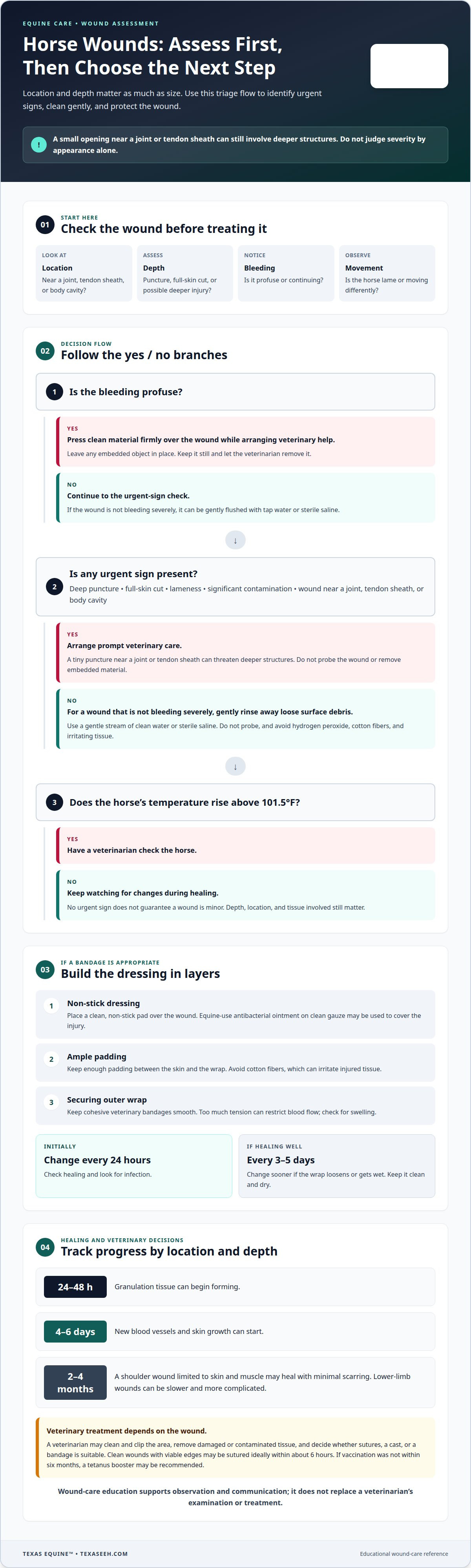
Apply a Dressing and BandagePlace a clean, non-stick pad over the wound, then add padding and a securing outer wrap. A gauze pad with antibacterial ointment intended for equine use can cover the injury. Keep cohesive veterinary bandages smooth, with ample padding between the wrap and skin. Check for swelling, as excess tension can restrict blood flow. Avoid cotton fibers, which can irritate injured tissue.
Change Bandages and Provide Stall RestChange the dressing every 24 hours initially to assess healing and check for infection. If healing well, change every 3-5 days, or sooner if the wrap loosens or gets wet. Ask the veterinarian about stall rest after stabilization; exercise depends on wound extent and location. Keep the bandage clean and dry.
Veterinarians may clean and clip a horse’s wound, remove damaged or contaminated tissue, and use sutures when appropriate. Whether sutures are suitable depends on the wound; a veterinarian may also use a bandage or cast based on its location. A clean gauze pad with antibacterial ointment intended for equine use can cover a wound and be secured in place.
Horse wound bandages should initially be changed daily to check for infection. They need enough padding between the skin and the wrap; incorrect bandaging can restrict blood flow. For proud flesh treatment, the wound may be bandaged and left alone for five to 10 days after topical medication is applied.
Assessing and cleaning horse wounds
For horse wound care, begin by noting the injury’s location, depth, bleeding, and any visible debris. Gentle cleaning can help protect the tissue while a veterinarian assesses injuries that may extend deeper.
Assess the Wound for InfectionAs part of horse wound care, inspect the wound for dirt, manure, hair, or other material that can introduce bacteria into injured tissues. Watch for changes during healing, and have a veterinarian check a horse whose temperature rises above 101.5 F. Infection risk also depends on wound depth and location; wounds near joints or tendon sheaths need careful veterinary evaluation, even when small.
Clean and Debride the WoundIf the wound isn’t bleeding severely, flush it with tap water or sterile saline. A gentle stream from a hose can wash away loose debris. Avoid hydrogen peroxide, which can damage sensitive tissue. Don’t probe the wound or remove embedded material. A veterinarian can clean and clip the area thoroughly, then remove damaged or contaminated tissue when needed. Avoid cotton, which can leave irritating fibers. A gentle approach supports effective horse wound care while protecting healthy tissue.
Track healing by site and tissue depth, not appearance alone. Granulation tissue can begin forming within 24-48 hours, with new blood vessels and skin growth starting 4-6 days after injury. A shoulder wound limited to skin and muscle may heal with minimal scarring in 2-4 months. Lower-limb wounds can be slower and more complicated, so follow changes closely.
Assessing and treating equine wounds
Assess severity by considering bleeding, depth, contamination, and location. A small opening can still involve a joint or tendon.
Identify Wounds Needing Immediate Veterinary CareArrange prompt veterinary care for profuse bleeding, lameness, full-skin cuts, deep punctures, or significant contamination. Treat wounds near joints, tendon sheaths, or body cavities as urgent: even a tiny puncture can threaten deeper structures. Don’t pull out an embedded object. Keep it still and let the veterinarian remove it safely, since disturbing it may worsen tissue damage or bleeding.
Tailor Care to the Wound LocationFor a leg injury, note its position relative to joints and tendons, then watch for swelling or changes in movement. Lower-limb wounds are prone to exuberant granulation tissue, sometimes called proud flesh, which can slow healing. Head and upper-body wounds generally have a better blood supply than lower-limb injuries, but depth and contamination still affect treatment. Gently rinse away loose surface debris, but don’t probe the wound.
Compare leg and body wounds by location, depth, and structures involved, not size alone. A small wound over a joint may be more harmful than a larger wound on the hip or shoulder.
Treatment costs in the United States vary with wound severity, location, and care required. Cleaning, sedation, sutures, casts, and follow-up needs can affect the total; a veterinarian assesses these factors.
For cleaning, dilute chlorhexidine by adding 20-25 milliliters per quart of water. Painkillers can mask severity, so consult a veterinarian before applying painkillers or topical treatments.
Texas Equine Education & Horsemanship™ Equine Care Classes
Sound decisions during an injury begin with a broader foundation in everyday horse care. Equine Care Classes offer an education-first way for horse owners and riders to build that foundation. Learning about equine care can help you observe changes, understand what information matters, and communicate clearly when veterinary guidance is needed.
There are clear limits to what wound-care education can do. A class can support learning, but it doesn’t replace a veterinarian’s examination or treatment. Useful observations include where the injury is, when it was noticed, whether bleeding continues, and whether the horse’s movement has changed. Sharing these details helps the veterinary team understand the situation and decide what assessment is needed.
Education can also help horse owners prepare before an injury occurs. Keep care supplies organized, learn to handle your horse calmly, and make a habit of noticing changes during routine care. These practices can make it easier to respond thoughtfully rather than improvise under pressure. For urgent or deep wounds, prioritize veterinary care over a lesson or general care guidance.
Texas Equine Education & Horsemanship™ connects equine care learning with practical horsemanship through its Equine Care Classes. These classes are a useful next step for people who want to strengthen foundational knowledge and feel more prepared for everyday care decisions, while recognizing when a wound needs veterinary attention.
Contact Texas Equine Education & Horsemanship™ to learn more about Equine Care Classes.
Frequently Asked Questions
How do you clean and treat a minor wound on a horse?
For a minor injury, horse wound care begins with deciding whether it’s truly superficial or needs veterinary assessment. Cleaning and treating a fresh wound during the first six hours can help reduce infection risk. If a skin flap remains after cleaning, it can be aligned to support natural healing. Don’t assume a small-looking wound is minor if it lies near a joint.
What antiseptics and wound dressings are safe for horses?
Use antiseptics only in diluted form, since full-strength solutions can harm the tissue being treated. Keep chlorhexidine and Betadine away from the eyes because they can cause irritation. For the dressing, follow the non-stick contact-layer and padding approach described above. If the wound is close to the eye or involves deeper tissue, seek veterinary direction before choosing products.
How do you bandage a horse wound and how often should you change the dressing?
Apply the dressing and wrap using the steps above, then observe how your horse moves and stands. Follow the change schedule already outlined, and compare the wound’s appearance each time you remove the bandage. Note any new changes or lameness, since movement can help indicate whether the injury needs further veterinary assessment. A bandage doesn’t replace follow-up care.


Comments