


Starting Horseback Riding as an Adult: Your Complete Beginner's Guide
- Kim Williams

- Aug 3
- 8 min read
Updated: Aug 8
Everything you need to know before your first horseback riding lesson—from what to expect and what to wear to building confidence around horses.
Have you always wanted to learn to ride?
Maybe you've admired horses since you were a child. Perhaps you've watched riders on scenic trails, visited a ranch while on vacation, or found yourself slowing down every time you passed a pasture.
For many adults, horseback riding has been a lifelong dream that simply got pushed aside by work, family, school, or the demands of everyday life.
The good news?
It's never too late to begin.
At Texas Equine Education & Horsemanship™, we've welcomed adult beginners from all walks of life. Some arrive excited. Others arrive a little nervous. Many wonder if they're "too old" to start or worry they'll be the only beginner in the barn.
The truth is, every experienced rider once stood exactly where you are now.
They all took that very first lesson.
Our goal isn't simply to teach you how to ride.
Our goal is to help you understand horses, build confidence, and develop the knowledge and skills that create a safe, rewarding partnership for years to come.
Because at Texas Equine™...
Where Horses Inspire Learning™
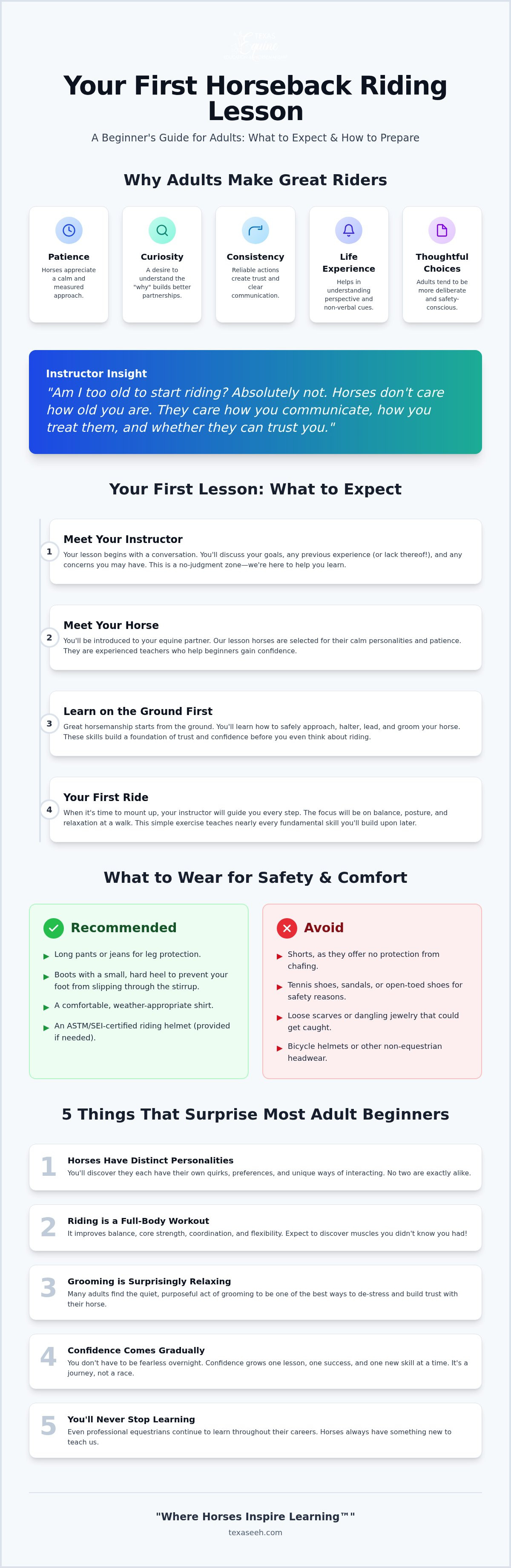
Why Adults Make Great Riders
One of the biggest misconceptions about horseback riding is that it's something you have to start as a child.
Nothing could be further from the truth.
Adults often become exceptional horsemen because they bring qualities that horses naturally appreciate:
patience
curiosity
consistency
life experience
thoughtful decision-making
Adult learners also tend to ask why.
Why does a horse pin its ears?
Why is grooming important?
Why do we mount from a block?
Why do horses respond to body language?
Understanding the "why" behind horsemanship creates better riders—and stronger partnerships.
At Texas Equine, we believe education is just as important as time in the saddle.
The more you understand your horse, the more confident you'll become.
Instructor Insight
One of the most common questions we hear is:
"Am I too old to start riding?"
Our answer is always the same:
Absolutely not.
Horses don't care how old you are.
They care how you communicate, how you treat them, and whether they can trust you.
What Makes Adult Lessons Different?
Learning as an adult is different than learning as a child—and that's okay.
Adult riders often appreciate a slower pace that allows time to ask questions,
understand concepts, and build confidence before moving on to new skills.
Rather than rushing through exercises, we encourage students to develop a solid foundation first.
That foundation includes much more than simply learning how to steer a horse.
You'll learn:
how horses think
how they communicate
how to approach safely
basic horse care
grooming techniques
proper handling
equipment basics
riding fundamentals
safety practices
These lessons help you become not only a rider, but a knowledgeable horseman.
Your First Lesson: What to Expect
One of the biggest sources of anxiety for new riders is simply not knowing what will happen.
Let's walk through a typical introductory lesson .
You'll Meet Your Instructor
Your instructor will begin by getting to know you.
You'll discuss any previous horse experience (even if that's "none"), your goals, and any concerns you may have.
Don't worry if you've never touched a horse before.
That's exactly why you're here.
You'll Meet Your Horse
One of the best parts of your first lesson is meeting your equine partner.
Lesson horses are carefully selected because of their calm personalities, patience, and reliability.
They're experienced teachers in their own right.
These horses have helped many beginners gain confidence and understand the basics of horsemanship.
Rather than expecting perfection, they simply ask for clear communication and kindness.
You'll Learn on the Ground First
Many people assume horseback riding begins the moment you climb into the saddle.
In reality, great horsemanship begins on the ground.
Before riding, you'll learn how to:
safely approach a horse
understand personal space
recognize basic body language
halter and lead a horse
groom safely
prepare the horse for riding
These skills help you build confidence while also developing trust with your horse.
Texas Equine™ Tip
Some of the most valuable lessons happen before you ever ride.
Learning how to safely handle and understand horses on the ground creates the foundation for everything you'll do in the saddle.
Building a Partnership
Horseback riding is unlike most sports.
You're not learning to operate a piece of equipment.
You're learning to communicate with a living, thinking partner.
Every horse has its own personality.
Some are curious.
Some are playful.
Some are incredibly patient.
Some enjoy working quietly and steadily.
As you spend time together, you'll begin noticing these differences.
You'll also learn that horses communicate primarily through body language.
Their ears...
Eyes...
Posture...
Movement...
All tell a story.
Learning to recognize those signals is one of the most rewarding parts of becoming a horseman.
What Will You Learn During Your First Ride?
When it's time to climb into the saddle, your instructor will guide you through every step.
Using a mounting block helps make mounting safer and more comfortable for both horse and rider.
Once seated, you'll focus on finding balance rather than trying to "ride."
Your instructor will help you understand:
proper posture
rein position
where your hands belong
where your legs belong
how to sit comfortably
how to relax
Most introductory lessons focus on walking.
While this may sound simple, walking teaches nearly every fundamental riding skill you'll build upon later.
Balance.
Rhythm.
Communication.
Confidence.
These skills become the foundation for every future ride.
What Should You Wear?
You don't need expensive riding clothes for your first lesson.
Comfort and safety are far more important than appearance.
Here's a simple guide:
If you're unsure about anything, simply ask before your lesson.
We're always happy to help you prepare.
Five Things That Surprise Most Adult Beginners
1. Horses Have Distinct Personalities
No two horses are exactly alike.
You'll quickly discover they each have their own quirks, preferences, and unique ways of interacting with people.
2. Riding Is a Workout
Horseback riding improves balance, coordination, flexibility, and core strength.
Many first-time riders are surprised to discover muscles they didn't even know they had!
3. Grooming Becomes a Favorite Activity
Many adults find grooming surprisingly relaxing.
It's purposeful.
And it's one of the best ways to build trust with your horse.
4. Confidence Comes Gradually
You don't have to become fearless overnight.
Confidence grows one lesson, one success, and one new skill at a time.
5. You'll Never Stop Learning
Even professional horsemen continue learning throughout their careers.
That's one of the wonderful things about horses.
They always have something new to teach us.
Preparing for Your First Lesson
Starting something new can feel exciting—and maybe even a little intimidating. That's completely normal.
The good news is that you don't need any previous experience to enjoy your first lesson.
You don't need to know horse terminology, own expensive equipment, or have any riding experience.
All you need is a willingness to learn.
Here are a few simple ways to prepare for your first visit.
Arrive a Little Early
Plan to arrive about 15 minutes before your lesson begins.
This gives you time to meet your instructor, become familiar with the facility, and settle into your new surroundings without feeling rushed.
It's also a great opportunity to ask questions before your lesson starts.
Dress for Comfort and Safety
Wear comfortable clothing that allows you to move freely.
Avoid clothing that could become caught on equipment, and leave jewelry that dangles or swings at home.
Most importantly, wear sturdy boots with a small heel. If you don't own riding boots yet, don't worry—many beginners start with boots they already have at home.
Bring a Positive Attitude
You don't have to know everything.
You aren't expected to ride perfectly.
Your instructor expects you to ask questions, make mistakes, and learn.
That's exactly what lessons are for.
What If You're Nervous?
Almost every adult beginner experiences some level of nervousness before their first lesson.
That's okay.
In fact, it's completely normal.
Horses are large animals, and beginning something unfamiliar naturally comes with questions.
"What if I do something wrong?"
"What if the horse doesn't like me?"
"What if I can't do it?"
The wonderful thing about learning with experienced instructors and well-trained lesson horses is that you're never expected to figure everything out on your own.
Every lesson builds upon the last.
You'll learn one skill at a time, practicing until you feel comfortable before moving on.
Before long, those first-day nerves are replaced with excitement.
Instructor Insight
One of the most rewarding moments as an instructor is watching an adult student realize they can do something they once believed was impossible.
Confidence isn't something you're born with—it's something you build through experience.
Learning Beyond the Saddle
Horseback riding is only one part of horsemanship.
Some of the most meaningful learning happens while you're grooming, leading, observing, and simply spending time with horses.
As your knowledge grows, you'll begin to understand why horses behave the way they do.
You'll learn how they communicate.
How they establish trust.
How they learn.
And perhaps most importantly, you'll begin to recognize how much they can teach us about ourselves.
Patience.
Consistency.
Problem-solving.
Leadership.
Humility.
These lessons often extend far beyond the barn. If you are interested in how other sports can also foster personal and spiritual growth, you can discover GolfFromtheHeart.golf to see how golf offers a similar path.
Why We Teach Horsemanship—Not Just Riding
At Texas Equine Education & Horsemanship™, we believe becoming a horseman means
much more than learning to sit in a saddle.
It means understanding the whole horse.
It means recognizing that every interaction—whether you're filling a water bucket, cleaning a hoof, or riding through an arena—is another opportunity to learn.
That's why our lessons emphasize education alongside riding instruction.
We want students to leave each lesson with new knowledge, greater confidence, and a deeper appreciation for these incredible animals.
Because when you understand the horse, riding becomes easier.
Communication becomes clearer.
And the partnership becomes stronger.
Texas Equine™ Tip
Don't compare your progress to anyone else's.
Every rider learns at a different pace, and every horse teaches different lessons. Focus on becoming a little more knowledgeable and confident with each visit.
Frequently Asked Questions
Am I too old to start horseback riding?
Absolutely not.
Adults begin riding every year, and many become lifelong equestrians. Horses don't measure your age—they respond to patience, consistency, and thoughtful communication.
Do I need to own a horse?
No.
Our lesson program provides carefully selected school horses that are experienced, dependable, and well-suited for beginners.
Will I ride during my first lesson?
Most introductory lessons include time in the saddle, but every lesson begins with important groundwork and safety instruction.
Learning to safely handle and understand your horse is just as valuable as learning to ride.
What if I've never even touched a horse?
That's perfectly okay!
Many of our students arrive with little or no horse experience.
Your instructor will guide you through each step, ensuring you feel comfortable and supported throughout your lesson.
Is horseback riding good exercise?
Yes!
Horseback riding improves balance, coordination, flexibility, posture, and core strength.
It's also a wonderful way to spend time outdoors while challenging both your body and your mind.
Your Journey Begins with One Lesson
Every experienced rider remembers their first lesson.
The excitement.
The uncertainty.
The first time they held a lead rope.
The first time they climbed into the saddle.
The first time they realized they could communicate with an animal that weighs over a thousand pounds through patience, understanding, and trust.
Those moments stay with you.
Learning to ride isn't about becoming perfect.
It's about developing confidence, building meaningful partnerships, and discovering just how much horses have to teach us.
Whether you've dreamed of riding for years or recently discovered a passion for horses, there's no "perfect" age to begin.
There's only the decision to take the first step.
At Texas Equine Education & Horsemanship™, we're honored to help students begin that journey in a welcoming, educational environment where questions are encouraged, progress is celebrated, and learning never stops.
Because every accomplished horseman was once a beginner.
And every remarkable journey begins with a single lesson.
Where Horses Inspire Learning™


Comments