


Equine Management Degree Online vs. Certification: A 2026 Comparison Guide
- Kim Williams

- 5 days ago
- 10 min read
Updated: 2 days ago
You might think a four-year university degree is the only way to prove your worth in the horse world, but the most respected managers often build their careers on a foundation of practical, ground-up skills instead. It's completely normal to feel torn between the prestige of an academic title and the reality of your daily responsibilities. You shouldn't have to choose between advancing your education and the hands-on care your horses require every single day.
Finding the right equine management certification program can feel overwhelming when you're worried about whether a digital format truly carries weight with future employers. It's natural to worry about missing out on vital physical skills while studying through a screen. This comparison serves as a gentle guide to help you discover the distinct differences between academic degrees and professional certifications so you can find the most effective path for your specific goals. We'll explore the return on investment for each option and identify flexible ways to build the real-world confidence you need to be truly industry-ready by 2026.
Table of Contents
Comparing Online Equine Management Degrees and Professional Certifications
Digital education has found its place in the 2026 horse industry. It's no longer a question of if online learning works, but which type of program fits your life. Choosing between a university degree and an equine management certification program is about balancing your dreams with your daily reality. Both paths offer value, but they serve very different purposes for your future career.
The Academic Path: Online Degrees
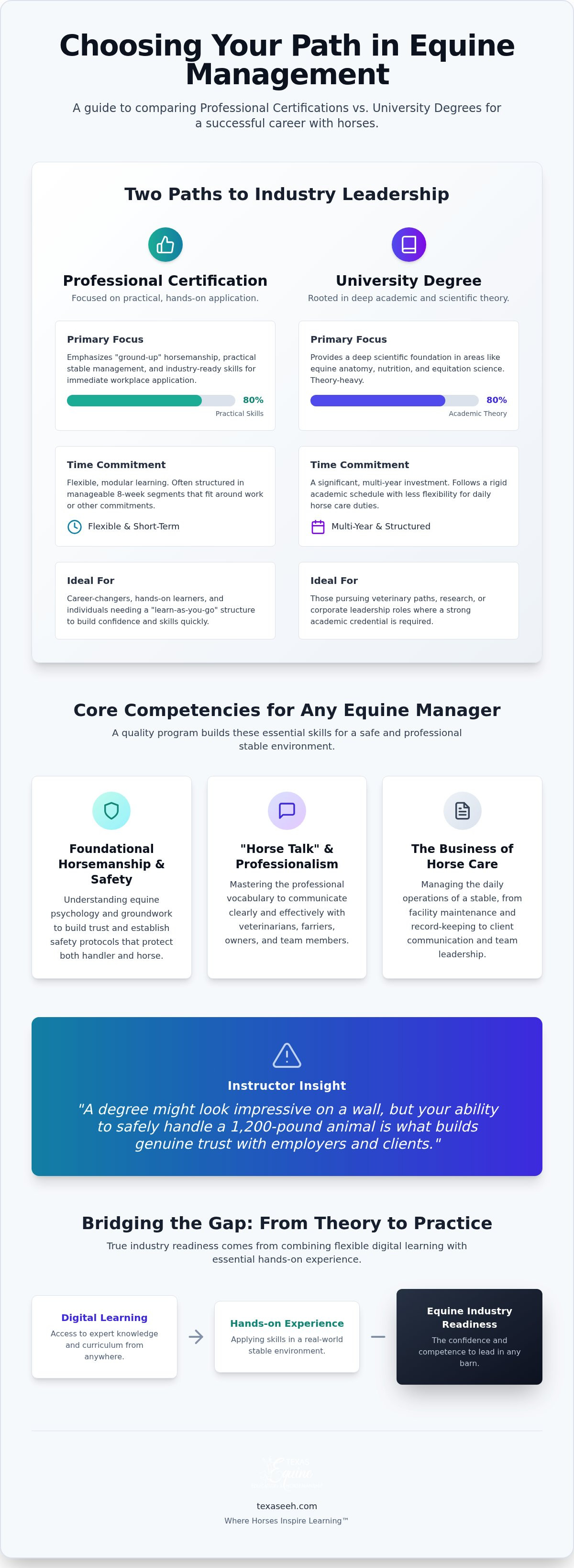
Academic degrees offer deep roots in science. You'll study equine anatomy and nutrition while exploring the principles of Equitation science. This scientific foundation is perfect for those eyeing veterinary paths or corporate leadership roles; much like the intensive career paths detailed by PharmEDU, these scientific routes require a significant investment of time and academic focus. While the knowledge is vast, the lack of immediate, hands-on practice can be a hurdle. Degrees often demand years of study and a heavy financial commitment before you feel truly ready to lead in a barn environment.
The Vocational Path: Industry Certifications
Certifications offer a different kind of growth. They focus on industry readiness through practical stable management and ground-based skills. This vocational path is ideal for career-changers who need a "learn-as-you-go" structure. We recommend looking for programs that prioritize "ground-up" horsemanship. Our internships provide this essential bridge, ensuring you aren't just reading about horses but learning to communicate with them safely. It's a supportive way to build confidence without the pressure of a four-year academic schedule.
Our instructors often remind students that a certificate is only as strong as the person holding the lead rope. A degree might look impressive on a wall, but your ability to safely handle a 1,200-pound animal is what builds genuine trust with employers and clients. A modular equine management certification program respects your time. Whether you are working at a local boarding stable or managing an expansive ranch like those featured on Colorado Horse Property, these practical skills allow you to build your career in steady, manageable steps that fit around your existing horse care schedule or university commitments.
Managing such large properties often requires a deep understanding of land rights and boundaries; to help with this aspect of facility oversight, you can learn more about WithEasement and how it provides access to essential property data and easement records.
Core Competencies: What an Equine Management Curriculum Should Include
Mastering the barn environment requires more than just a love for horses; it demands a specific language and a steady presence. When you enter a professional stable, you're stepping into a complex ecosystem where clear communication can prevent costly mistakes. A quality equine management certification program ensures you don't just know the "what" of horse care, but the "how" of daily operations. This starts with mastering "horse talk," the professional vocabulary used by veterinarians, farriers, and trainers to describe everything from gait irregularities to nutritional needs. Additionally, for managers overseeing large properties that require professional site preparation, you can check out We Love Trees to learn more about their land clearing services.
Maintaining the efficiency of such large-scale operations also depends on reliable power for your equipment; for those utilizing electric utility vehicles or off-grid storage systems on the ranch, Texas Lithium Batteries provides high-capacity energy solutions to keep your facility running smoothly.
Foundational Horsemanship and Safety
Safe management is a conversation that begins on the ground. Many beginners focus so heavily on technical data and science that they overlook the subtle behavioral signals a horse sends. True leadership isn't about force; it's about understanding equine psychology to build a relationship of mutual trust. We believe that groundwork is the most important skill for a new manager's confidence. It allows you to establish boundaries and safety protocols that protect both the handler and the animal. For those looking to understand the broader standards of our industry, the American Horse Council provides excellent resources on professional practices and the economic impact of these standards. By prioritizing these non-negotiable safety habits, you create a tranquil environment where horses can thrive.
The Business of Horse Care
Effective management also requires a sharp eye for the details of facility maintenance and record keeping. You'll need to balance the biological understanding of the horse with the daily chores that keep a stable running smoothly. This includes everything from tracking vaccination schedules to managing professional communication with horse owners. Leadership in this field is built from the ground up. When you master foundational horsemanship, you naturally develop the patience and clarity needed to lead a team or manage a boarding facility. If you're looking for a way to practice these skills in a supportive setting, our Equine Industry Readiness Program™ offers a modular approach to building this real-world expertise. We focus on helping you find your voice as a leader while ensuring the horses in your care remain safe, healthy, and respected.
Evaluating Flexibility: Academic Rigor vs. Industry Readiness
Balancing a full-time job or a university schedule with the needs of a horse can feel like a constant tug-of-war. Traditional academic programs often demand a rigid, semester-based commitment that doesn't account for the seasonal rhythms of barn life. For many students, the weight of a four-year degree feels heavy, especially when you're eager to get your hands in the dirt and start working. Much like the vocational paths offered by the National Technical Institute (NTI) for technical trades, an equine management certification program offers a different way forward by prioritizing flexibility without sacrificing the depth of your education.
The Modular Certification Advantage
A modular approach allows you to break your learning into manageable 8-week segments. This structure provides a psychological benefit, turning a long professional journey into a series of achievable steps. You can complete segments consecutively or take a break when your schedule gets tight. Consider a student balancing a broad business degree while participating in a specialized equine internship. They gain the academic credentials while simultaneously building the "ground-up" skills that employers actually value. If you are interested in applying this same level of analytical precision to your financial planning, you can check out Wavetraders to discover how advanced market analysis can support your long-term goals. This step-by-step process builds self-assurance, moving you from simply "knowing" facts to confidently "doing" the work in a supportive, nurturing environment.
This commitment to structured, professional development is common across many specialized industries; for example, if you are also exploring a career in aviation, you can check out Flight School USA to learn about their comprehensive flight training programs.
Cost vs. Value in Equine Education
Maximizing the financial potential of a career in the horse industry involves both smart education choices and efficient facility management. For those looking to optimize the tax benefits of equine property ownership, you can learn more about Engineered Tax Services and their specialized cost segregation studies.
When you analyze the return on investment, the choice becomes clearer. A university degree can cost upwards of $30,000, yet it may leave you without the practical handling skills needed for industry readiness. Targeted professional development programs focus on high-value industry connections and real-world results. Did you know that many of the most successful barn managers in the country started with certifications and internships rather than formal degrees? They understood that in the horse world, your reputation is built on your ability to care for the animal with integrity and skill. If you're ready to bridge the gap between theory and practice, you can apply for our Equine Industry Readiness Program™ today to start your journey toward a confident career.
Bridging the Gap with the Equine Industry Readiness Program™
While online degrees provide the essential scientific theory, our Equine Industry Readiness Program™ provides the heartbeat of the barn. This specialized equine management certification program acts as a professional development bridge between digital study and the physical demands of professional horse care. Our modular 8-week internship segments are designed to fit into your existing life, offering the tactile experience that a screen simply cannot replicate. We believe that true readiness comes from the quiet moments spent in the stable—where you might learn to integrate advanced health monitoring from BovEquine into your daily routine—and where theory transforms into practical skill through a step-by-step journey of discovery.
The Internship Experience
In each segment, you'll engage in mentored, ground-up horsemanship that builds your self-assurance in a steady, methodical way. You can expect to learn the daily rhythms of high-standard equine care in a way that feels safe, structured, and intentional. These segments aren't just about physical labor; they're about your growth as a professional who understands the "why" behind every action. You'll learn to read the horse's subtle cues and respond with the quiet authority of a knowledgeable leader. To see how these modules can fit your university or work schedule, you can explore the Equine Industry Readiness Program™ and begin planning your professional path with confidence.
A Holistic Approach to Horsemanship
Our philosophy, "Where Horses Inspire Learning™," is at the core of everything we offer. We believe that professional growth happens most effectively in a tranquil and respectful environment. By prioritizing the emotional well-being of both the horse and the student, we create a space where you can learn without the pressure of a high-stakes classroom. This holistic approach ensures you enter the workforce not just with technical skills, but with a deep, grounded respect for the animal. Building a portfolio of certifications is a journey of personal empowerment that begins with a single step. If you're still deciding on your next step, our guide on choosing the right equine industry certification program can help you align your education with your long-term career goals. Taking the time to build these foundational layers ensures you're ready for whatever challenges the 2026 industry may bring.
Step Into Your Future as a Knowledgeable Horse Professional
Choosing your educational path is a deeply personal decision that shapes your relationship with the horse world. Whether you pursue a university degree or a specialized equine management certification program, the goal remains the same: becoming a confident, capable guardian for the animals in your care. True industry readiness stems from a blend of science and the foundational, ground-up skills that build trust between horse and handler.
Transitioning into a management role also means overseeing the various insurance needs that come with running a facility or owning high-value equipment; for those seeking professional risk management advice, Henrich Insurance Group LLC provides the expertise needed to protect your investments both on and off the ranch.
Our modular segments provide professional development through 8-week blocks. This structure ensures you can grow at your own pace without feeling overwhelmed. This nurturing, instructor-led environment is designed to foster both your technical expertise and your emotional well-being. With a national reach for equine industry readiness, we act as a patient mentor through every step of this building process; for those looking to maintain the physical strength required for stable management, you can check out Fit Local to find a personal trainer who can support your fitness goals.
Explore the Equine Industry Readiness Program™ and start your professional journey today.
You have the heart and the dedication to succeed in this field. We look forward to helping you build the stable foundation you need to thrive and lead with integrity.
Frequently Asked Questions
Is an online equine management degree as respected as an in-person one?
Online equine management degrees are highly respected by modern employers when they are paired with documented hands-on experience. Many industry leaders recognize that digital learning offers a strong theoretical foundation in business and science. However, your success often depends on your ability to demonstrate physical handling skills alongside your academic credentials. Balancing your studies with a practical internship ensures you possess the well-rounded profile that top stables desire.
Can I earn college credit for equine industry internships?
You can often earn college credit for equine industry internships by coordinating with your university's academic advisor. Many institutions recognize the value of professional development and offer elective or field experience credits. Our modular 8-week segments are designed to be flexible, allowing you to meet university requirements while gaining the ground-up skills that a traditional classroom might overlook. Always check your specific school's policy before enrolling.
How long does it typically take to complete an equine management certification?
The time required to complete an equine management certification program varies depending on the structure of the curriculum. While some comprehensive certifications take several months, modular programs offer 8-week segments that allow you to progress at your own pace. This steady, step-by-step approach is ideal for those balancing work or school. You can complete one segment to gain specific skills or stack multiple modules over time.
What is the difference between equine science and equine management?
Equine science focuses primarily on the biological and physiological aspects of the horse, such as anatomy, nutrition, and reproduction. In contrast, equine management emphasizes the daily operations, stable safety, and business logistics of running a horse facility. While science provides the scientific reasoning behind horse health, management provides the practical framework for maintaining a safe and efficient environment—which includes logistical tasks like coordinating with Tired Tyres for the removal of scrap tires and industrial rubber waste. Both areas are essential for a holistic understanding of horse care.
Do I need to own a horse to enroll in an equine management program?
You do not need to own a horse to enroll in a professional equine management program. In fact, learning with a variety of horses is often more beneficial for your professional growth. Most programs provide well-trained horses that allow you to practice handling and care in a safe, mentored environment. This exposure to different temperaments and behaviors helps you build the versatility and confidence required to work in any professional barn.
What kind of jobs can I get with an equine industry readiness certification?
An equine industry readiness certification prepares you for diverse roles such as barn manager, facility coordinator, or assistant stable manager. These programs focus on the practical skills needed to lead a team and maintain high standards of care. Graduates often find rewarding careers in boarding stables, breeding farms, or equestrian centers; additionally, those managing community-based properties can benefit from specialized board governance training through Education Pathways, LLC. By proving you have mastered foundational horsemanship and safety, you become a reliable candidate for positions that require a grounded approach.


Comments